The average home cook loses minutes every day to small frustrations: hunting for the measuring spoons, digging past three lids for the right pan, moving five jars to reach one spice. Kitchen organization ideas fix these moments permanently by giving every item a logical home based on how you actually cook. A well-organized kitchen does not just look better in photos — it makes weeknight cooking faster, cleaning easier, and shopping lists shorter, because you can finally see what you own.
Organize by Zones, Not by Cupboard
Professional kitchens are arranged around tasks, and home kitchens should be too. Create a prep zone near your main worktop with knives, boards, and mixing bowls; a cooking zone around the hob with pans, utensils, and oils; a baking zone with flour, tins, and measuring tools; and a cleaning zone under the sink. When every item lives where it is used, cooking stops being a walking tour of the room.
Start by emptying one zone at a time and being honest about duplicates. Most kitchens hold three spatulas, two broken peelers, and a gadget bought for a recipe made once in 2019. These kitchen organization ideas begin with subtraction: fewer, better tools in the right place beat a drawer full of maybes.
Fix the Drawers and Cupboards
Deep cupboards are where ingredients go to be forgotten. Replace the dig with systems: pull-out racks for pots, a lazy Susan in corner cupboards, and clear stackable containers for dry goods so you see quantities at a glance. In drawers, use dividers or simple trays — one for cutlery, one for utensils, one for the small tools that otherwise form a tangled nest.
Door backs are free storage hiding in plain sight: slim racks hold spice jars, wraps, and lids. If your kitchen is genuinely small, this guide to small kitchen storage solutions that create space from nothing goes further, with shelf risers, vertical dividers for trays, and other ways to multiply cupboard volume without touching a wall.
A Pantry System You Can Maintain
Decant the staples you use weekly — rice, pasta, flour, lentils — into matching clear containers with labels and dates, and group the rest by meal: breakfast items together, baking together, tins together. Keep a running shopping list on the fridge and add items the moment they run low, not on shopping day from memory. First in, first out: new stock goes behind the old so nothing quietly expires at the back.
Fridge organization pays the same dividends. Use one shelf for leftovers with a strict three-day rule, keep raw meat sealed on the lowest shelf, and store herbs like flowers in a jar of water — they will last twice as long and remind you to use them.
Clear Counters, Calm Cooking
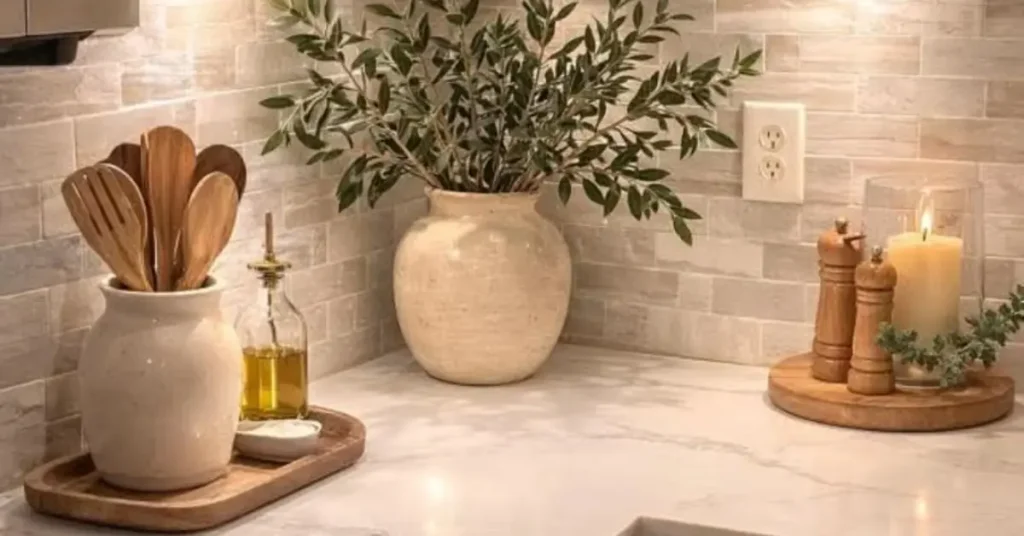
Counter space is cooking space, so guard it. The only appliances that earn a permanent spot are the ones used daily — for most homes that means the kettle and perhaps the coffee maker. Everything else lives in a cupboard, and the toaster and blender genuinely are quick to fetch. A single tray or small basket can corral the unavoidable: oil, salt, and the utensil crock by the hob.
This is where good kitchen organization ideas meet daily habit: a two-minute reset after dinner — surfaces wiped, items returned to their zones, dishwasher running — means every morning starts with a kitchen that is ready instead of one that needs tidying before breakfast can begin.
Small Tech That Earns Its Counter Space
Organization is not only about boxes and shelves — a little well-chosen technology removes daily friction too. A smart plug can put the coffee maker on a morning schedule so it is ready when you are, a simple voice assistant on the counter sets timers, converts measurements, and adds to the shopping list while your hands are busy, and under-cabinet lights on a motion sensor end the era of chopping in your own shadow. The principle from these kitchen organization ideas still applies: every device must earn its place by being used daily, or it becomes clutter with a plug.
If you are choosing your first devices, this starter guide to smart home gadgets for beginners explains the simple options in plain language and warns against the classic mistake of buying gadgets before your storage basics work. Get the cupboards and zones right first; then let one or two smart helpers remove the annoyances that remain.
Getting the Whole Household On Board
The finest system in the world lasts one week if only one person understands it. Label shelves lightly while the system is new — inside cupboard doors is enough — and put things back where guests and family can find them without asking. Agree on the two or three rules that matter most, usually “counters clear at night,” “new stock behind old stock,” and “everything has a zone,” and forgive the rest.
Children can own small parts of the system happily: a low drawer with their cups and snacks, a hook for the school lunchbox. When everyone can find things and put them away, the kitchen stops depending on one person’s memory, and the organization survives holidays, guests, and busy weeks — which is the real test of any system.
Keep the System Alive
Organization decays without tiny maintenance. Once a month, spend ten minutes checking dates, wiping one shelf, and evicting anything that has not been used since the last check. Once a season, review your zones honestly: if the whole family now bakes on Sundays, the baking zone deserves a promotion to a better cupboard.
Small, consistent care beats annual overhauls every time. Set up zones, fix the drawers, systemize the pantry, defend your counters — and your kitchen will start paying you back in saved minutes every single day. Pick one drawer or one cupboard this weekend rather than attempting the whole room, and let that single calm, ordered space motivate the next one. Organization spreads the same way clutter did: one small area at a time, except this time in the right direction.